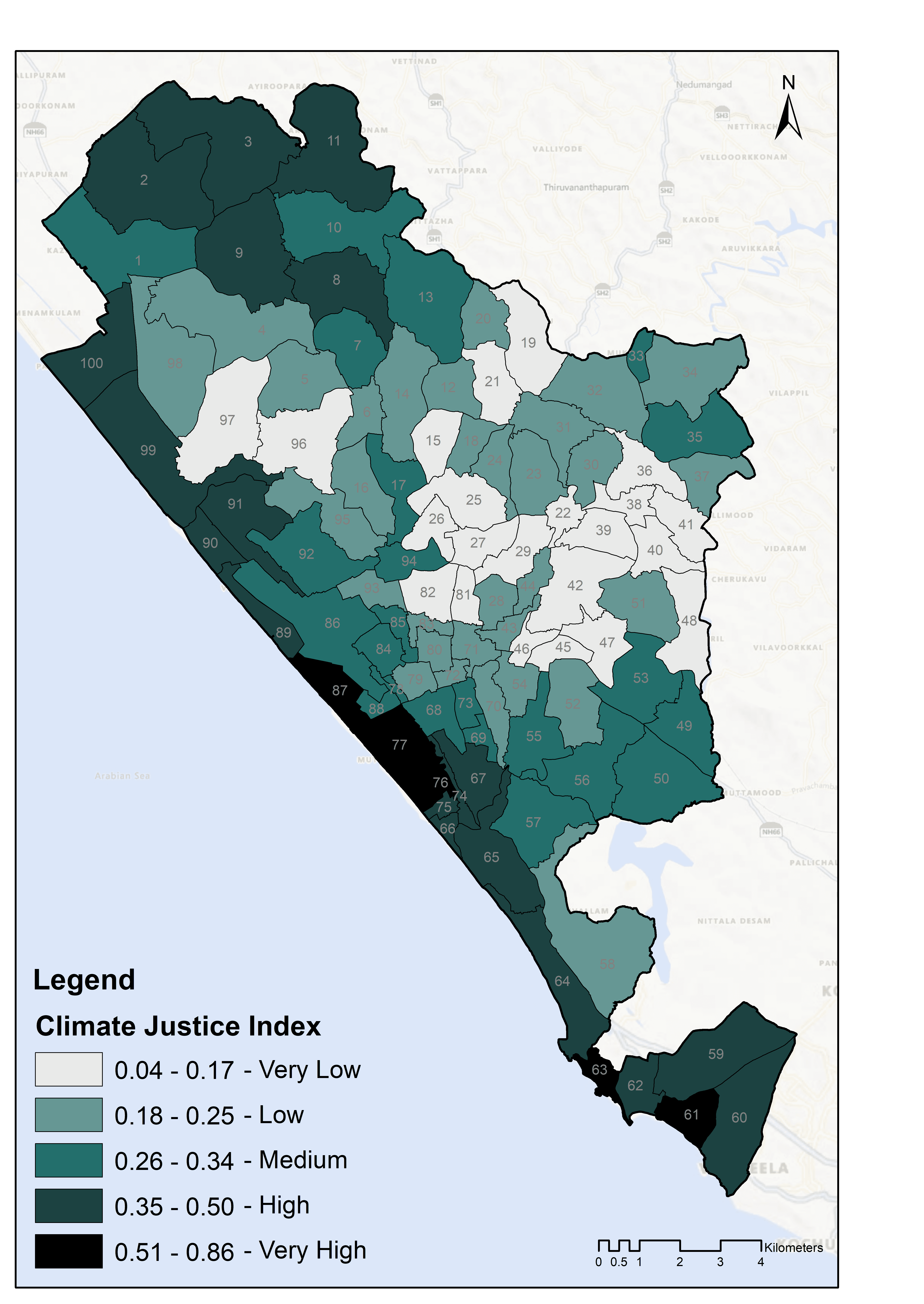


Mapping Climate Injustice: A Spatial Climate Justice Index for Trivandrum
A first-of-its-kind ward-level Climate Justice Index for Thiruvananthapuram Municipal Corporation — quantifying the gap between climate losses borne by coastal communities and investments made to protect them.
Thiruvananthapuram's 27.4 km coastline is home to some of Kerala's most vulnerable communities — fishing villages where households face annual losses from flooding, coastal erosion, and storm surges, yet receive only a fraction of the investment needed to recover. This study asked a fundamental question: are the communities most exposed to climate risk also the least protected by public investment? By combining a multi-hazard risk map (flood susceptibility + shoreline erosion) with a full monetary valuation of climate-related losses and a ward-level accounting of government investments, the study produced India's first Spatial Climate Justice Index — a quantitative measure of where the system is failing the people it should protect most.
Thiruvananthapuram Municipal Corporation covers 212.84 sq.km across 100 wards, with 15 coastal wards directly exposed to the Lakshadweep Sea. The district records the highest coastal erosion rate in Kerala at 23%, while 45% of Kerala's coastline is classified as vulnerable. The city's 992,499 residents include 120,367 urban poor, the majority concentrated in coastal fishing communities.
Climate justice, as applied here, is the principle that communities bearing the greatest burden of climate change consequences — through no fault of their own — deserve proportionately greater protection and investment. Standard planning assessments measure hazard and vulnerability. This study went further: it measured whether public institutions were responding to that vulnerability with justice.
The study covered three interconnected analyses:
Physical hazard assessment using DSAS-based shoreline change analysis (2003–2023) and weighted flood susceptibility mapping across 9 parameters.
Socio-economic and infrastructure vulnerability mapping using Principal Component Analysis (PCA) across 45+ indicators, producing ward-level composite risk scores.
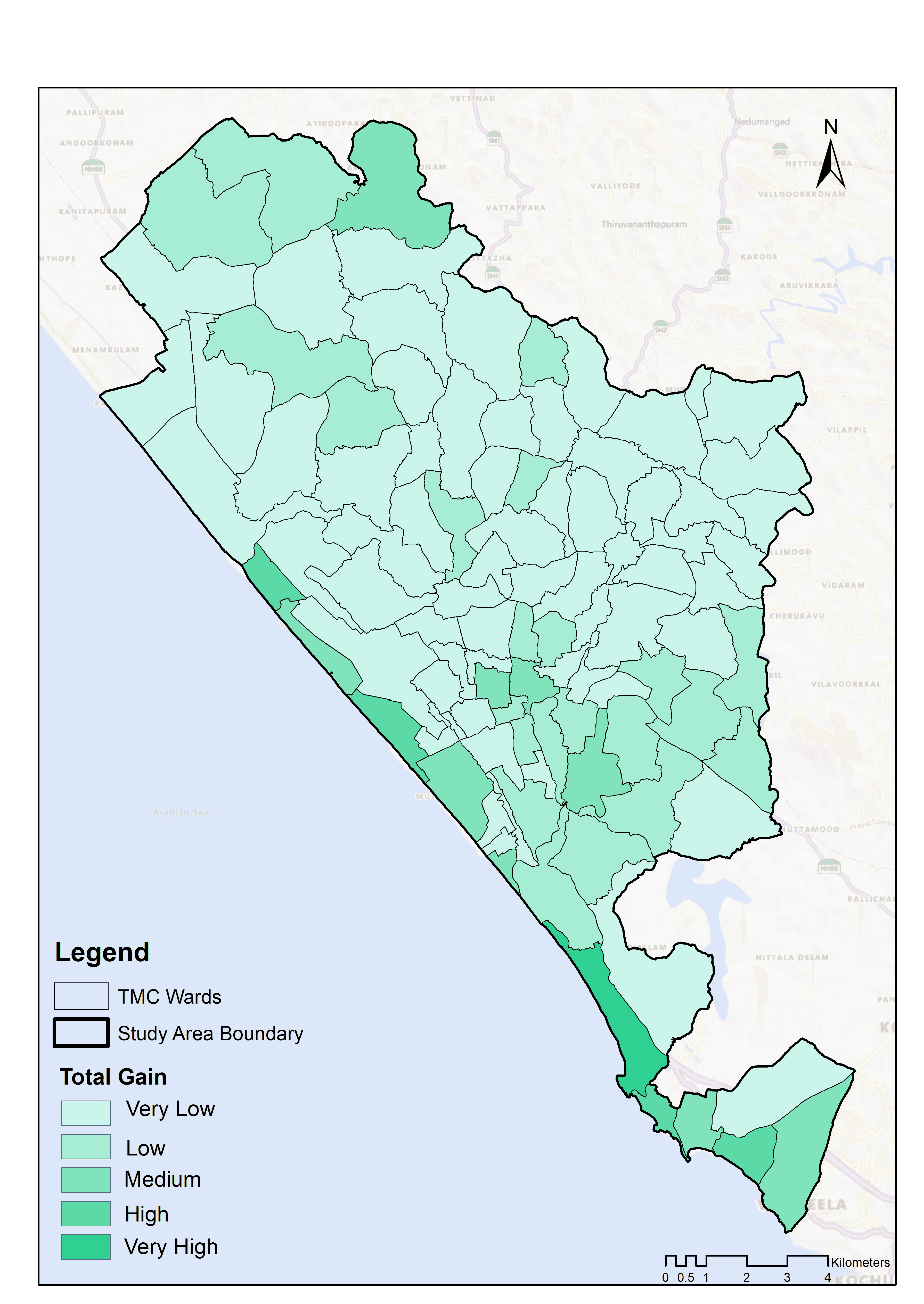
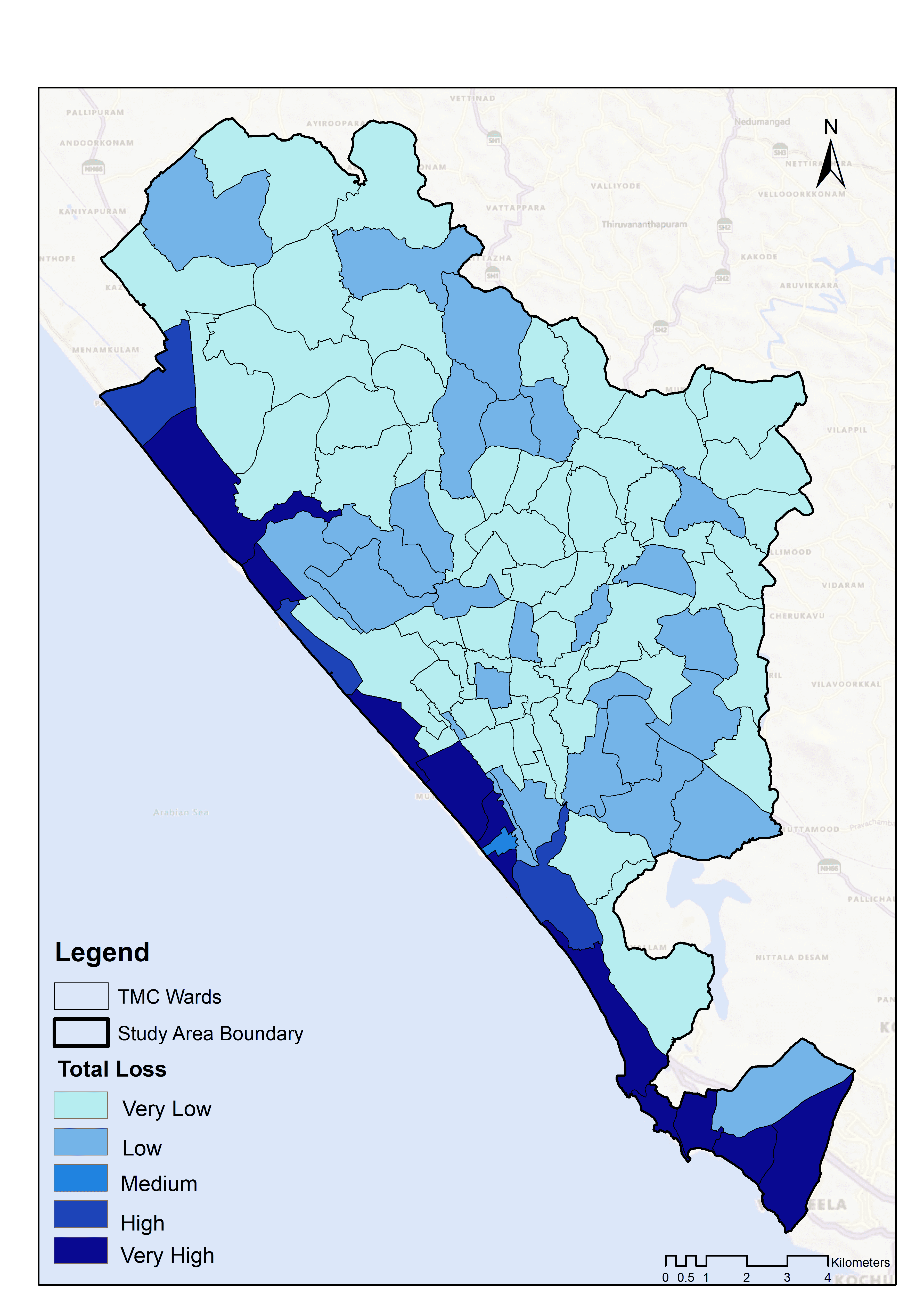
Monetary valuation of losses (infrastructure damage, health costs, land loss to erosion, livelihood losses from agriculture and fisheries) against gains (flood relief funds, coastal protection investments, livelihood earnings) — yielding a net climate balance for every ward in the city.
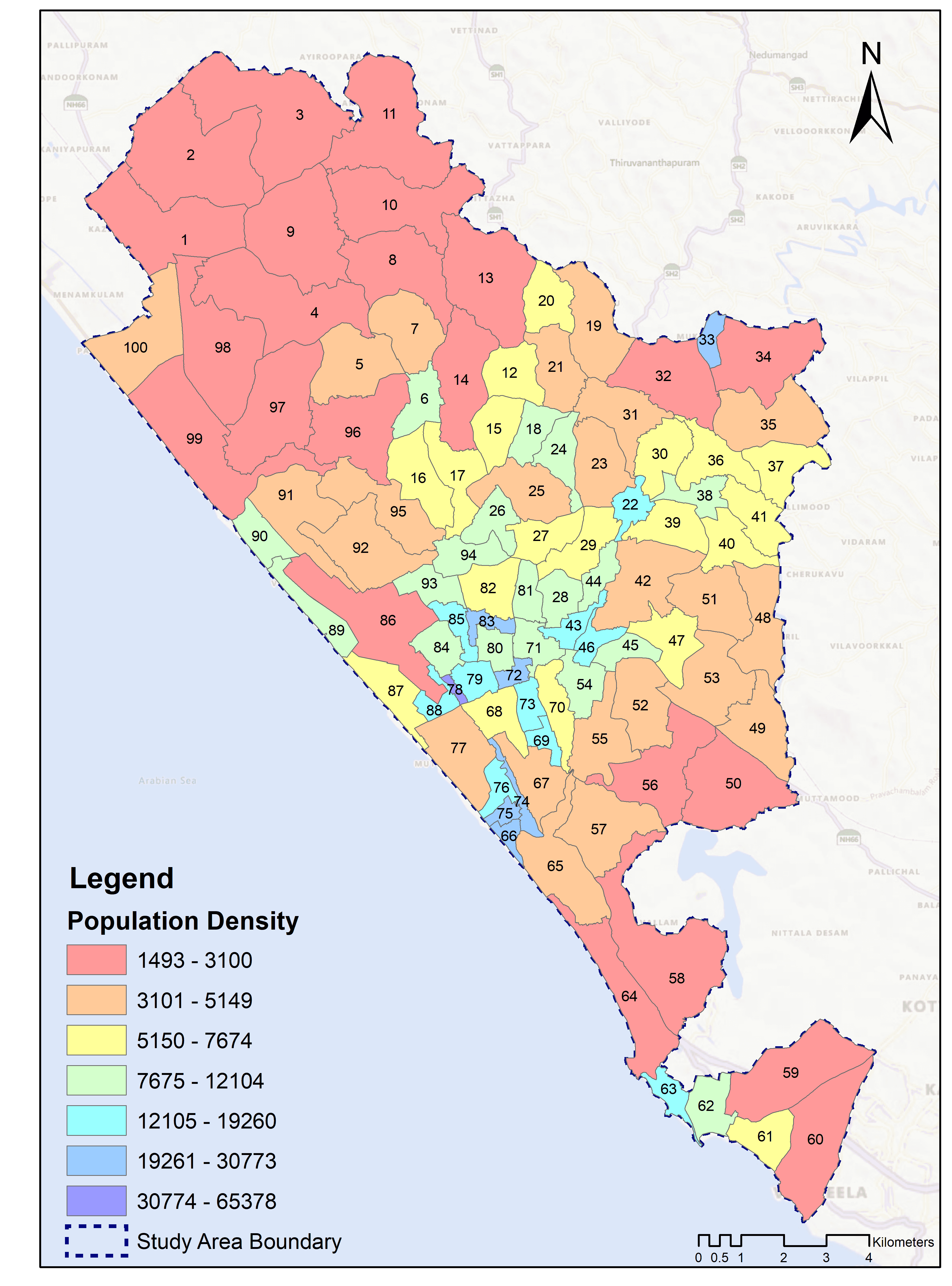
∙ Climate risk in Thiruvananthapuram is spatially concentrated but financially diffuse — coastal wards bear the highest hazard exposure yet receive flood funds that are distributed across broader administrative zones, diluting investment where it is most needed.
∙ Shoreline change data revealed that Valiyathura, Harbour, and Vizhinjam wards are eroding at 4.15 metres per year, destroying land valued under Kerala Coastal Zone Development Authority fair-value rates — yet no compensatory mechanism existed in the municipal budget to account for permanent land loss.
∙ 40% of wards showed high or very high infrastructure vulnerability, primarily due to poor access to essential services — not physical damage alone. This meant that the communities most at risk were also the least equipped to respond or recover.
∙ The municipal corporation's own revenue-to-total revenue ratio stood at just 40%, against a desired self-reliance threshold of 90%, severely limiting its capacity to fund climate action from internal sources.
∙ There was no existing mechanism for climate budget tracking, no ward-level loss accounting, and no framework for identifying which communities were being systematically under-served by adaptation investments relative to their risk exposure.
The study developed a three-stage analytical framework culminating in the Climate Justice Index (CJI):
Stage 1 — Risk mapping: Multi-hazard susceptibility was modelled by overlaying flood parameters (rainfall, elevation, slope, TWI, soil type, distance from rivers, LULC, storm surge exposure) with DSAS-derived shoreline change rates from three epochs of Landsat imagery (2003, 2013, 2023). This produced a ward-level risk map identifying 10 high-risk wards, all concentrated on the coastal edge.
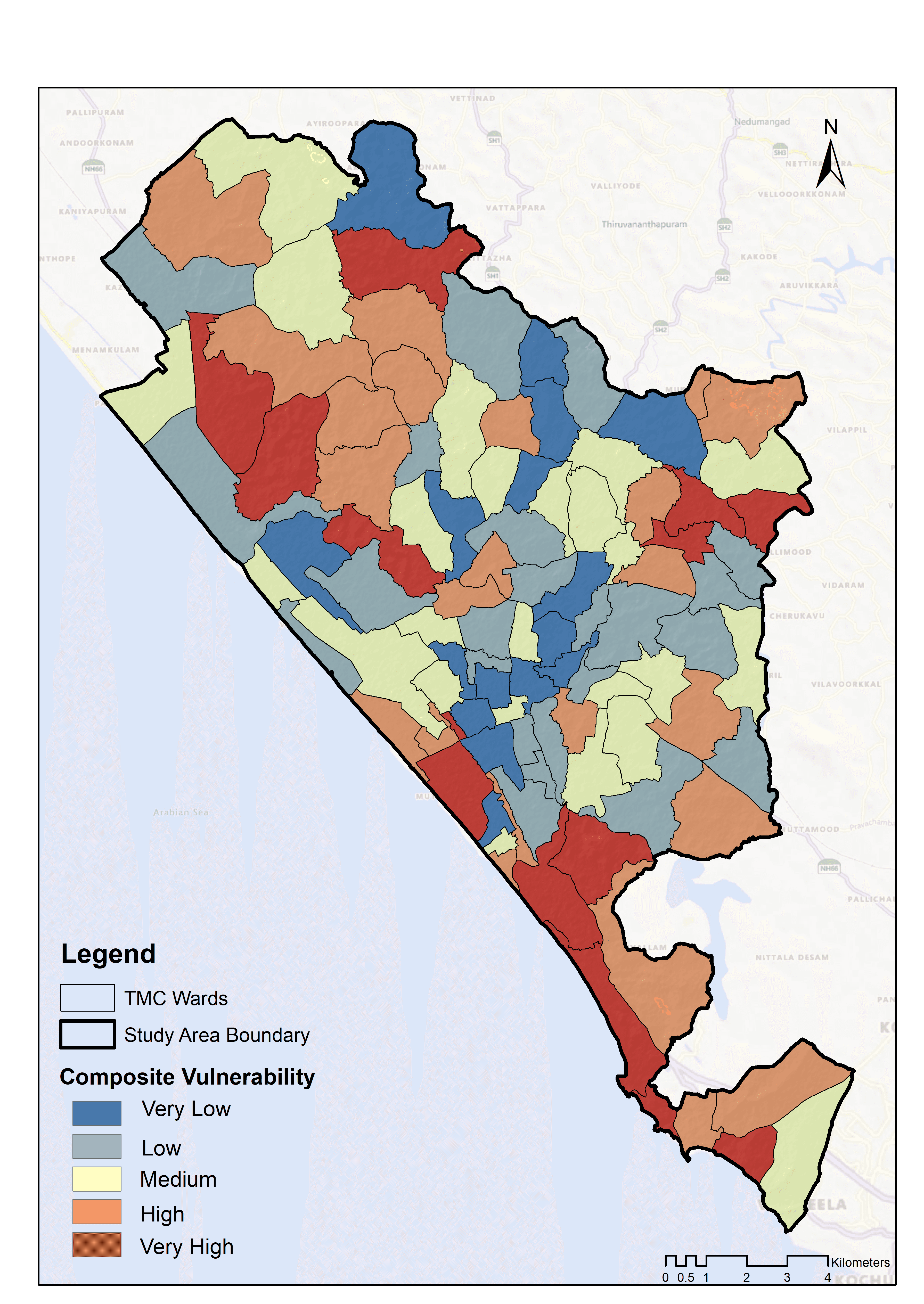
Stage 2 — Vulnerability and livelihood indexing: Principal Component Analysis was applied to 45+ socio-economic and infrastructure indicators across all 100 wards. The PCA yielded a Social Vulnerability Index (7 components, 72.4% variance explained) and an Infrastructure Vulnerability Index (9 components, 76.4% variance explained), which were combined into a Composite Vulnerability score. A Sustainable Livelihood Index assessed all five livelihood capitals (Human, Social, Physical, Financial, Natural) at ward level.
Stage 3 — Monetary valuation and the CJI: All climate-related losses were monetised using direct market valuation — infrastructure repair costs, health expenditure during flood events, land fair-value loss to erosion, and fisheries/agriculture livelihood losses. These were set against documented gains: KCDA and SDMA/NDMA flood funds, coastal protection expenditure, and livelihood earnings. The resulting net figure per ward, normalised against the risk score, produced the Spatial Climate Justice Index. A Gini coefficient analysis confirmed high inequality across all three dimensions — loss (0.5385), livelihood (0.3319), and risk (0.4321).
The study identified 9 wards as systemically climate-unjust — including Mulloor, Kottapuram, Harbour, Vellar, Poonthura, Bheemapalli East, Bheemapalli, Valiyathura, and Poonducavu. These wards carry the highest combined hazard and vulnerability scores while receiving the lowest proportional investment in protection and recovery.
At the city level, the annual climate deficit stands at ₹279.66 crore — total losses of ₹447.62 crore against total investments and gains of ₹167.93 crore. Coastal erosion alone accounts for ₹188.29 crore in annual land and livelihood losses, making it the single largest contributor to the climate finance gap.
The study also produced a proposed climate budget of ₹345.5 crore for 2024–2025, benchmarked against four Indian cities and states (Surat, Pune, Meghalaya, Tamil Nadu), and outlined a participatory budgeting process with ward and circle-level meetings, climate budget tagging using Climate Change Relevance Share (CCRS) and Climate Change Sensitivity Share (CCSS), and a 5-year ward-level risk reassessment cycle.
The framework has been designed to be adopted by the municipal corporation as a living governance tool — enabling TMC to track, report, and improve its climate justice performance year on year.
Annual climate finance deficit — the gap between losses borne by coastal communities and investments made to protect them
₹279.66 Cr
Identified as systemically climate-unjust — highest risk exposure, lowest proportional investment
9 wards